AmandoMed.

Online appointment booking for German practices and medical care centres. Designed by Shared Human Business — frontend led, built, and evolved by us, from day one.

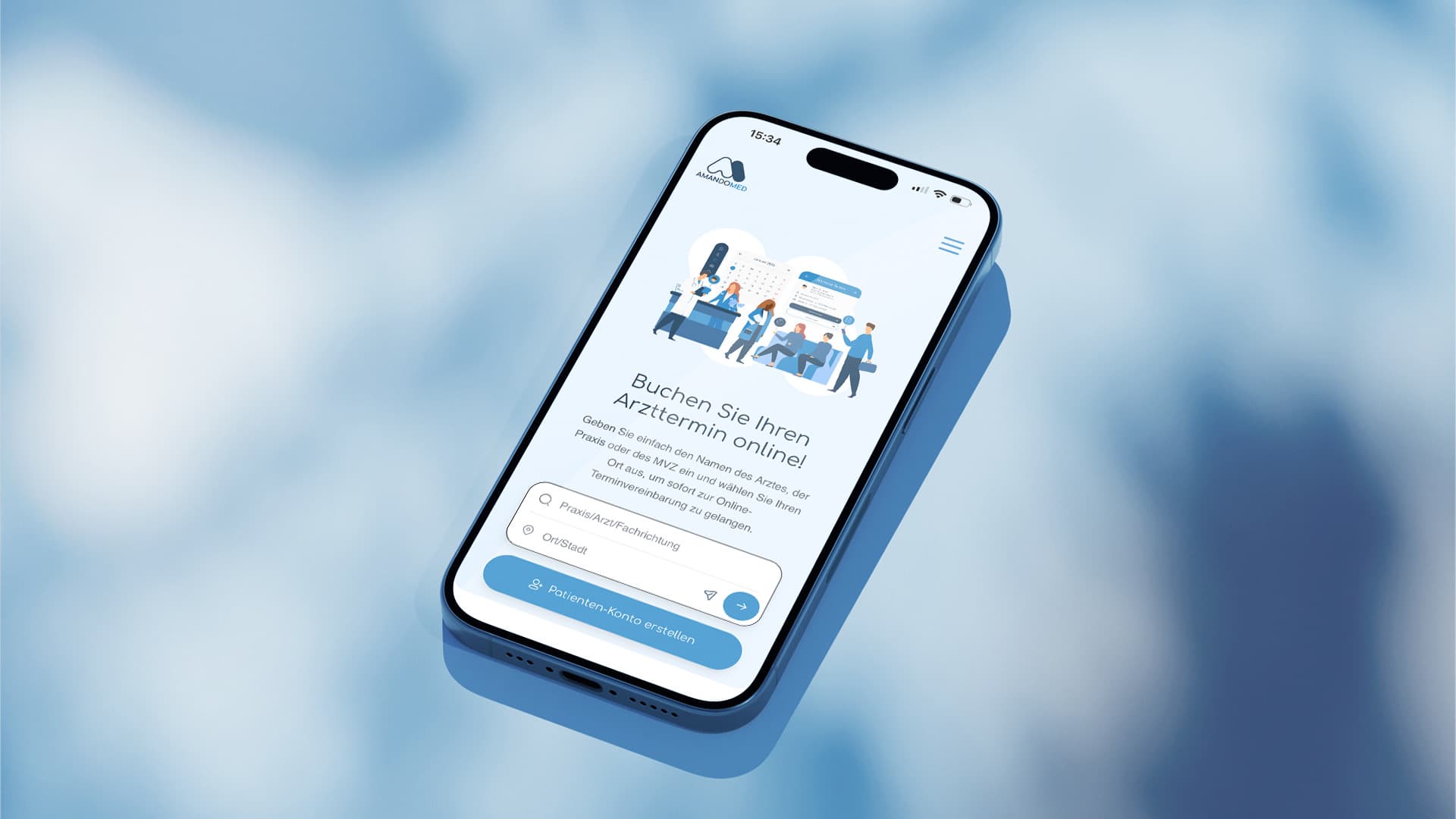
AmandoMed booking platform homepage on a phone — 'Buchen Sie Ihren Arzttermin online!' above search fields for practice, doctor, specialty, and location
termine.amandomed.de — the live booking platform
Client
AmandoMed — digital healthcare, Germany
Design
Shared Human Business — our design partner
Build
Vitale Systems — frontend lead, day one to today
Stack
React 18 · TypeScript · Vite · Tailwind CSS · TanStack Query
Timeline
In build since August 2025 · evolving weekly
The brief

From search to confirmed appointment.

AmandoMed builds software for German medical practices and MVZs. Their Termin-Plattform lets patients find a practice, a doctor, or a specialty and book an appointment online — no phone queue, no waiting-room forms. The design direction comes from Shared Human Business, the same design partner whose own platform we engineer.

We lead the frontend, and have since day one in August 2025: the booking funnel, patient accounts, an embeddable booking widget for partner sites, and the typed integration layer over AmandoMed’s live API. The platform is live at termine.amandomed.de — and we keep shipping on it every week.

By the numbers
0/7booking, without the phone queue
0surfaces from one booking flow
0patient journeys under automated test
0months of weekly shipping

In build since August 2025. Frontend lead, every week since.

The craft

Engineered for trust.

Healthcare software carries a different weight. The engineering has to carry it too.

01

One funnel, every surface

The same booking flow powers the main platform and the partner embed. One codebase, themed per surface — a fix in the funnel ships everywhere at once.

02

Anonymous by design

The embeddable widget never touches auth. Enforced twice — at the React context and in the HTTP client — so a logged-in patient stays anonymous inside a partner's iframe.

03

Accessibility as a requirement

WCAG AA wasn't a nice-to-have, it was regulatory. Full keyboard navigation, German screen-reader labels, and a search that works without ever touching a mouse.

04

Contracts, not guesses

A typed adapter layer maps every backend field and enum before it reaches the UI. When the API drifts, the build catches it — not a patient mid-booking.

The build

What we shipped.

01

The booking funnel

Search by practice, doctor, or specialty; pick a slot; reserve and confirm against the live API. Engineered as one reusable flow — slot reservation, pre-booking forms, confirmation emails.

02

Patient accounts

Multi-step signup, sign-in with session refresh, and a protected dashboard for appointments, family members (Angehörige), and profile management.

03

Embeddable booking widget

An iframe any practice website can drop in: the full funnel inside third-party pages, with a consent banner, postMessage sizing to the parent page, per-partner branding, and hard-enforced anonymous auth.

04

Typed API integration

An adapter layer between backend and UI — endpoint modules, enum and field mappings, a token store, TanStack Query for caching and retries. The frontend moved from mocks to the live API without rewriting screens.

05

Discovery & landing pages

Search results with doctor cards, practice detail pages with Leaflet-powered multi-location maps for MVZ groups, and a landing-page system for specialties and locations.

06

Quality gates & compliance

Vitest unit suites, Playwright end-to-end tests across auth, search, booking, and session refresh, recurring production-readiness audits — plus GDPR surfaces: Datenschutz, consent, tokenised appointment-cancellation links, and a German-language help centre.

Your product could be next

Want something built like this?

Subscribe for ongoing frontend engineering, or scope it as a fixed-term project — same team that builds AmandoMed.